
First Quarter 2026 Data
During the period from 1 January to 31 March 2026, the dataset contained 19,737 messages, of which 5,531 were posted in January, 3,185 in February, and 11,021 in March. Activity increased significantly in March, with clear peaks on 20 January, 26 February, and 14 March. On these days, the number of messages was more than two standard deviations above the average.
The overall level of toxicity remained relatively low throughout the research period. The average toxicity score was 0.15 in January, February, and across the dataset as a whole, increasing slightly to 0.20 in March. Only a very small number of messages (between 10 and 50 messages, less than 1% of the total dataset) received a toxicity score above 0.8 (between 0-1). The most common forms of toxicity were consistently related to political themes, often in combination with contempt, ridicule, racism, religion, sexism, or hatred against Jews. In January and March, the most common combination was politics and hatred against Jews, while in February, politics and religion most frequently occurred together.
Approximately 2 to 3% of messages contained threatening language. Common toxic keywords throughout the research period included Zionists, jihad, terrorist, bitch, whining, scum, deport from the country, Kees, idiot, Hamas, plandemic, Quran, Islamisation, and left-wing scum. These terms reflect a combination of antisemitic, anti-Muslim, anti-migration, misogynistic, and politically polarising narratives. Examples of highly toxic messages included statements such as “They are filthy left-wing terrorists!!!!” and messages spreading anti-Muslim or conspiracy-related rhetoric. Although the proportion of highly toxic messages remained limited, the dataset shows that political discussions were the main driver of toxicity and were regularly accompanied by racist and antisemitic expressions.
Dominant Narratives in the Online Debate
The word clouds below show the 50 most frequently occurring toxic keywords in January, February, and March 2026, as well as across the first quarter of 2026 as a whole. The size of each word reflects how frequently it occurs relative to the other terms. The word clouds show that politics remained the dominant theme throughout the first quarter of 2026. The word politics consistently emerges as the most prominent keyword in January, February, March, and in the overall quarterly dataset. This indicates that toxic online discussions were primarily driven by political topics rather than by isolated incidents or individual events. A second clear trend is the strong presence of violence-related language. Terms such as violence, death, murdered, attacks, fighting, destroying, threat, and victims occurred frequently throughout the research period. In January, words such as riots, murdered, and revolution were particularly prominent, pointing to discussions characterised by violence and social unrest. Although these terms also occurred frequently in February and March, the emphasis shifted more towards attacks, unsafe, and threat, indicating a growing focus on security and threats within the political debate.
The data also show a continued intertwining of political discussions and identity-related narratives. References to Islamic, Muslims, Islamisation, Allah, Hamas, and jihad show that discussions about Islam and Muslims played a central role throughout the quarter. At the same time, recurring references to Israel, israel, Zionists, and antisemitism point to the continued prominence of discussions surrounding the conflict in the Middle East and antisemitic narratives. Domestic politics also played an important role.
Terms such as GroenLinks, left, left-wing, right, democracy, elite, and Kaag recur in all monthly word clouds. This suggests that toxic online discussions regularly focused on political parties, politicians, and ideological opponents. These discussions were not limited to substantive political positions but were often accompanied by insulting language and references to violence. Clear anti-migration and exclusionary narratives were also visible throughout the quarter. Words such as foreigners, our country, population replacement, multicultural, Dutch person, and white occur repeatedly in the dataset. These terms reflect discussions about national identity, migration, and demographic change and often appeared in combination with political and security-related terminology. This reinforces narratives in which migration and diversity are portrayed as threats to society.
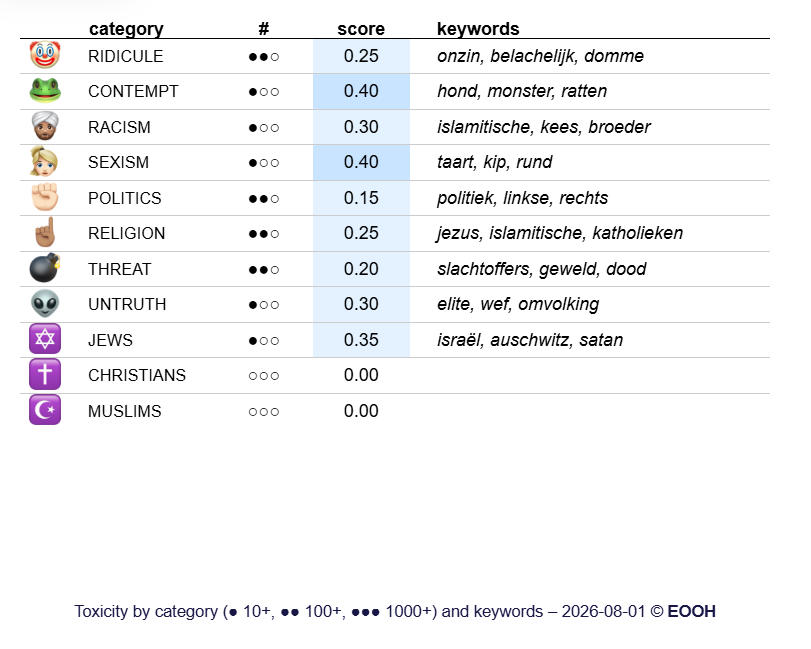
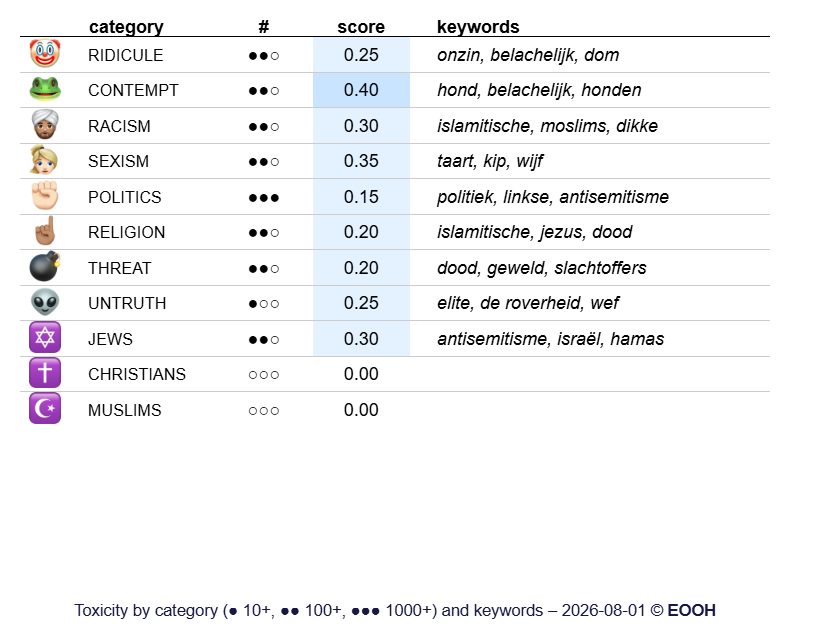
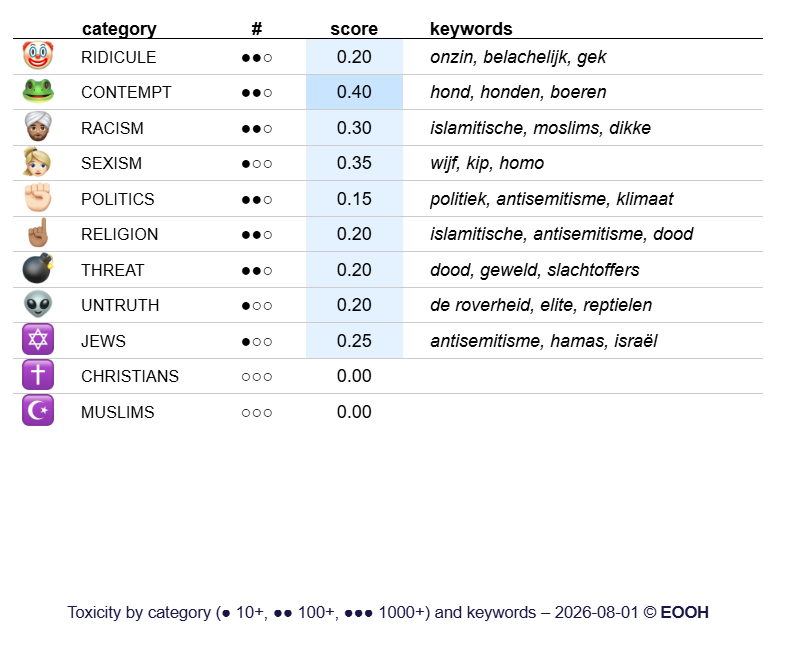
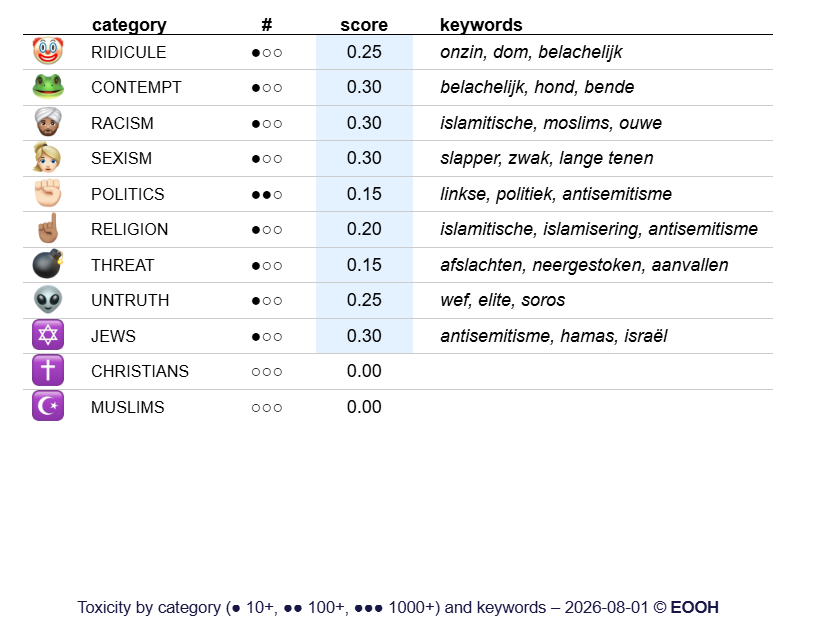
The word clouds therefore confirm the findings of the toxicity analysis. Although the overall toxicity level remained relatively low throughout the research period, online discussions were consistently characterised by a combination of political polarisation, violent rhetoric, anti-Muslim and antisemitic narratives, anti-migration discourse, and identity-based hostility. This shows that political events regularly acted as catalysts for broader hateful and exclusionary online conversations. The tables below provide an overview of the different toxic categories identified in the dataset from January through March 2026. The black dots indicate the relative frequency with which each category occurs. The analysis of the different toxic categories shows that the nature of online discussions remained relatively stable throughout the first quarter of 2026. Politics was the most dominant category in every month and received the highest classification in the quarterly overview. This confirms that political topics were the main driver of toxic online conversations.
The category of racism also remained consistently present. Terms such as Islamic and Muslims appeared in every month, indicating that anti-Muslim narratives formed an important part of toxic online expressions throughout the quarter. Notably, in March, the keyword fat was added to this category, suggesting that discriminatory expressions also targeted other personal characteristics.
Sexist expressions were also visible throughout all months, although the nature of the language used changed somewhat. Whereas words such as cake, chicken, and cow were particularly common in January, this shifted in March towards more explicit insults such as bitch, while gay also appeared as a frequently occurring keyword. This points to an increase in insults directly targeting identity.
A clear development is visible within the religion category. In January, the emphasis was still on religious concepts such as Jesus and Catholics, while in February and March the focus shifted towards Islamisation, antisemitism, and Islamic. This suggests that religious discussions became increasingly intertwined over the course of the quarter with social and political debates about Islam and the conflict in the Middle East.
The threat category also remained present throughout the quarter. In January, terms such as victims, violence, and death were central, while in February words such as slaughter, stabbed, and attacks occurred more frequently. In March, the emphasis shifted back to death, violence, and victims. This shows that violent rhetoric was a recurring feature of online discussions.
Conspiracy and disinformation narratives also remained visible throughout the quarter. Words such as WEF and elite appeared every month. In March, the term de roverheid—a Dutch derogatory wordplay combining 'government' (overheid) with 'robber' (rover)—and the keyword reptiles also appeared, indicating a shift towards more explicit anti-government and conspiracy narratives.
Finally, the categories relating to Jews and antisemitism show a clear development. Whereas words such as Israel, Auschwitz, and Satan dominated in January, from February onwards antisemitism, Hamas, and Israel became particularly prominent. This shift suggests that online discussions became increasingly influenced over the course of the quarter by current geopolitical developments and the conflict in the Middle East.
Overall, the categorical analysis confirms the earlier findings from the toxicity analysis and the word clouds. Political discussions formed the main context in which toxic expressions occurred during the first quarter of 2026. These were consistently accompanied by contempt, racist and religious narratives, antisemitic and anti-Muslim expressions, violent rhetoric, and conspiracy thinking, with different forms of online hate and polarisation mutually reinforcing one another.
Analysis of the Distribution of Toxic Categories
The graphs below provide an overview of the number of messages per toxic category during January, February, March, and the first quarter of 2026. A distinction is made between highly toxic messages (toxicity score > 0.8), moderately toxic messages (score > 0.2), and messages with low toxicity (score ≤ 0.2).
The data show that politics was by far the largest category throughout the entire research period. Not only did this category contain the highest number of messages, but politics also remained dominant among moderately and highly toxic messages. The strong increase in the number of political messages in March reflects the overall rise in online activity identified earlier in the dataset. Despite this increase, the proportion of highly toxic messages within the political category remained relatively limited, indicating that the growth was primarily driven by a greater volume of political discussion rather than a substantial increase in extremely toxic content.
After politics, ridicule, religion, racism, and contempt were the most common categories. These categories remained visible throughout all months and followed a similar pattern to the political category: the absolute number of messages increased in March, while their relative proportions remained largely stable. This suggests that the increase in activity primarily resulted in the wider dissemination of existing narratives rather than the emergence of new forms of online hate.
The categories of threat and religion also stand out because they contain a relatively high number of messages with a moderate toxicity score (>0.2). This indicates that threatening language and religion-related discussions occur relatively frequently, but only escalate to the highest toxicity category to a limited extent. A similar pattern can be observed within racism and sexism, where the majority of messages also have a lower toxicity score, while a small group of highly toxic messages remains present.
It is also notable that highly toxic messages (score >0.8) remain relatively rare across all categories. Although they occur within almost every category, they represent only a small proportion of the total number of messages. This is consistent with the earlier finding that the overall level of toxicity remained relatively low throughout the first quarter.
The main challenge therefore lies not so much in a large number of extremely toxic messages, but rather in the large volume of low to moderately toxic content that is continuously present within political and societal discussions. Finally, the graphs show that untruth remained the smallest category throughout the entire period. Sexism and profanity were also considerably less common than political, religious, or racist expressions. However, this does not mean that these categories are unimportant; they often form part of broader toxic narratives in which different forms of hate and polarisation intersect.
Conclusion
The analyses of the first quarter of 2026 show that online toxicity in the dataset examined is characterised not so much by a large number of extremely hateful messages, but primarily by a continuous stream of low to moderately toxic political discussions. Political topics constituted the main context in which toxic expressions occurred throughout the research period. These discussions were consistently accompanied by racist, antisemitic, anti-Muslim, and anti-migration narratives, as well as insulting and violent rhetoric.
Notably, the nature of the online conversations remained relatively stable throughout the three months. Although the number of messages increased significantly in March, the content of the discussions changed very little. The same narratives, targets, and forms of toxicity recurred throughout the quarter. This suggests that online hate is not driven exclusively by isolated events, but also stems from underlying and long-term societal debates in which the same themes are repeatedly reactivated.
Furthermore, both the word clouds and the categorical analyses show that different forms of hate rarely occur in isolation. Political discussions regularly become intertwined with religious tensions, antisemitism, anti-Muslim expressions, racism, misogyny, and conspiracy narratives. This overlap demonstrates that online hate increasingly consists of a combination of different constructions of perceived enemies, with societal and political developments acting as catalysts for broader polarising discourses.
Another important finding is that violent language remained clearly present throughout the research period. Although only a small proportion of messages reached a very high toxicity score, many more messages contained references to violence, threats, or exclusion. This underlines that the impact of online hate should not be assessed solely on the basis of the most extreme expressions. The continued normalisation of hostile, dehumanising, and polarising language can also contribute to an online environment in which discrimination and hate are increasingly perceived as acceptable.
Finally, the analyses show that online toxicity is strongly influenced by current political and societal developments. Discussions about domestic politics, migration, religion, and international conflicts, particularly the conflict in the Middle East, constituted the main breeding ground for toxic online interactions during the first quarter of 2026. This highlights the importance of continuous monitoring in order to identify at an early stage which societal developments lead to an increase in polarising and hateful online discussions.