
Second Quarter 2026 Data
During the period from 1 April to 30 June 2026, the dataset contained 30,375 messages, of which 14,460 were posted in April, 9,329 in May, and 6,586 in June. Activity was highest in April and subsequently decreased gradually over the course of the quarter.
The overall level of toxicity remained relatively low throughout the research period, with an average toxicity score of 0.20 in April, May, June, and across the second quarter as a whole. Only a very small number of messages (approximately 45 messages, less than 1% of the total dataset) received a toxicity score above 0.8.
The most common forms of toxicity during the quarter were related to politics, contempt, racism, profanity, and ridicule. While April was characterised by a relatively stronger presence of contempt, in May the emphasis shifted more towards political expressions and profanity. In June, sexism also became more visible alongside contempt, racism, and profanity. Approximately 2% of all messages contained threatening language. In addition, disinformation emerged clearly as a separate category only in May, when it was identified in approximately 1% of messages.
The most common combinations of toxic categories also changed slightly over the course of the quarter. In April, the most common combination was religion and threat, while in May and in the quarterly overview as a whole, the combination of politics and hatred against Jews was dominant. In June, this shifted to politics and threat, indicating that political discussions were increasingly accompanied by threatening and hostile rhetoric.
Common toxic keywords during the second quarter included: Kees, whining, scum, stupid, hate-beards, jihad, rubbish, cowardly, bitch, Mocro, shoot dead, Heil Hitler, deportation of Jews, goddammit, faggot and exterminate**. These terms reflect a combination of antisemitic, anti-Muslim, anti-migration, misogynistic, anti-LGBTIQ+ and politically polarising narratives. Examples of highly toxic messages included expressions targeting Muslims, references to extremist violence, and explicit calls for exclusion or extermination.**
Although the proportion of highly toxic messages remained limited during the second quarter, the dataset shows that political discussions continued to be the main driver of online toxicity. These discussions were consistently accompanied by racist, antisemitic, anti-Muslim, and other forms of identity-based hostile narratives. The continued presence of threatening language further underlines that political and societal developments also constituted an important breeding ground for broader hateful and exclusionary online discussions during the second quarter of 2026.
Dominant Narratives in the Online Debate
The word clouds below show the 50 most frequently occurring toxic keywords in April, May, June, and across the second quarter of 2026 as a whole. The size of each word reflects how frequently it occurs relative to the other terms. As in the first quarter, politics remained the dominant theme throughout the second quarter of 2026. The word politics is among the most prominent keywords in all monthly word clouds and in the quarterly overview. This confirms that political discussions remained the main context in which toxic online expressions occurred.
A notable development compared with the first quarter is the even stronger presence of violence-related language. Terms such as violence, death, victims, murder, murdered, fighting, riots, destroying, threat, attacks, and unsafe feature prominently in almost all of the word clouds. In April in particular, there was a strong emphasis on riots, violence, and victims, while in May words such as murdered, attacks, and revolution became more visible. In June, death, violence, and murder remained dominant. This indicates that discussions throughout the quarter were strongly characterised by threats, violence, and social unrest.
In addition, the interconnection between political discussions and identity-based narratives remains clearly visible. References to Islamic, Muslims, Allah, headscarf, brother, wallah, and Moroccans show that discussions about Islam and ethnic minorities remained prominent throughout the quarter. References to Israel, antisemitism, and genocide also recur frequently, indicating that the conflict in the Middle East and the societal debate surrounding it continued to play an important role in toxic online conversations.
Domestic societal issues are also strongly represented. Words such as Dutch person, left, right, farmers, democracy, elite, population replacement, diversity, and asylum crisis indicate that discussions about national identity, migration, and political divisions remained an important breeding ground for toxic expressions. Notably, terms such as white, fat, chicken, dog, gay, faggot, and hot stuff show that personal characteristics and identities were also frequently the target of insulting or discriminatory language.
Compared with the first quarter, the second quarter also appears to show a broader range of targets. Whereas the focus previously lay primarily on antisemitic, anti-Muslim, and anti-migration narratives, the second quarter saw more frequent references to women, LGBTIQ+ people, farmers, ethnic groups, and societal institutions. This resulted in a broader range of identity-based targets of hostility within the same political discussions.
The word clouds therefore confirm the findings from the toxicity analysis. Although the overall level of toxicity remained relatively low during the second quarter, online discussions were characterised by a persistent combination of political polarisation, violent rhetoric, anti-Muslim and antisemitic narratives, anti-migration discourse, and identity-based hostility. Notably, violent language appears to have been even more prominent in the second quarter than in the first quarter, suggesting that societal and political events increasingly gave rise to threatening and polarising online discussions.
The table below provides an overview of the different toxic categories identified in the datasets for April, May, June, and the second quarter of 2026 as a whole. For each category, the relative frequency, average toxicity score, and most frequently occurring keywords are presented.
The results show that the overall structure of online discussions remained largely stable throughout the second quarter. Ridicule, contempt, racism, politics, religion, and threat were among the most common categories in every month. This confirms that online toxicity during the quarter was not driven by one specific event, but by recurring societal and political discussions in which the same forms of hostility repeatedly emerged.
Politics remained the central context in which many toxic expressions occurred. However, the associated keywords shifted over the course of the quarter. In April, terms such as Israel, politics, and antisemitism were central. In May, the emphasis shifted towards antisemitism, left-wing, and politics, while in June terms such as Hamas and headscarf became more prominent. This indicates that current societal events and international developments continually provided new angles for the same polarised political discussions.
Within the religion category, the focus also remained largely centred on Islam and the conflict in the Middle East throughout the quarter. While April was primarily characterised by the combination of Islamic, Israel, and death, in May the emphasis shifted towards Eid al-Adha and antisemitism. In June, headscarf and amen played a greater role. This development shows that religious discussions remained closely connected to political and societal events.
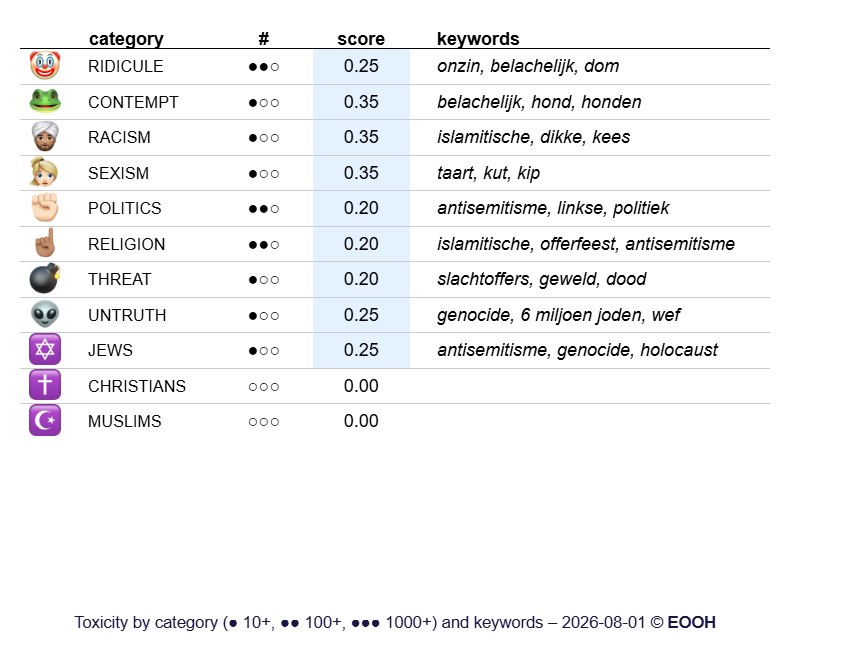
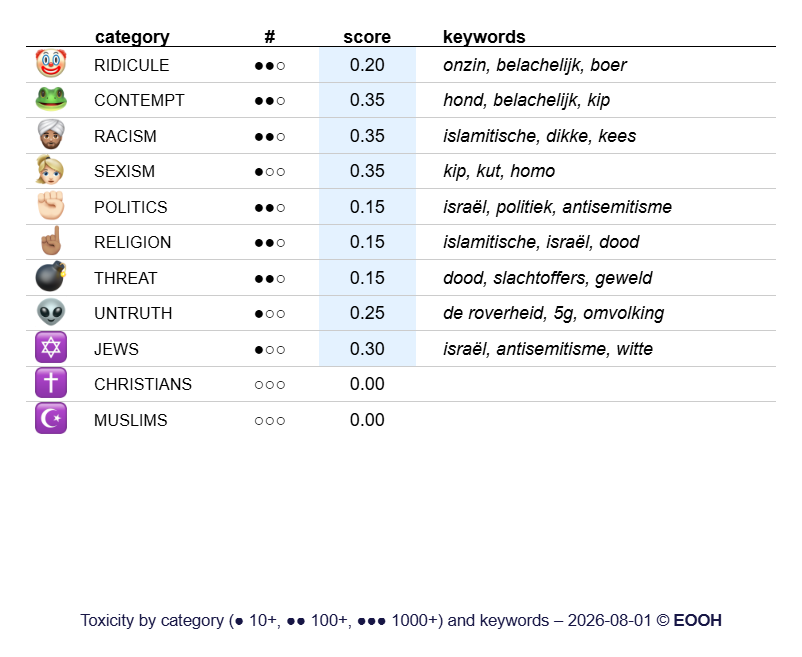
The threat category is consistently characterised throughout the quarter by words such as violence, death, and victims. In June, the emphasis shifts somewhat towards terms such as riots and rioters, suggesting that discussions were more frequently related to social unrest and public order. At the same time, the average toxicity scores within this category remained relatively stable.
Within the racism category, the keywords remained remarkably consistent. Terms such as Islamic, fat, Kees, and Muslims recurred throughout all months. This indicates that racist expressions during the second quarter did not focus on one specific target group but instead formed a recurring part of broader identity-based discussions. Sexism also remained present, with recurring keywords such as chicken and cunt, while the specific insults varied slightly from month to month.
An interesting development can be observed within the untruth category. In April, the emphasis was on conspiracy theories such as 5G, population replacement, and de roverheid [a derogatory Dutch wordplay combining “government” with “robber”]. In May, this shifted towards terms such as genocide, 6 million Jews, and WEF, while in June words such as wappies [a derogatory Dutch term commonly used for conspiracy theorists], paedophiles, and corrupt system dominated. This shows that disinformation continually responded to current societal issues throughout the quarter, while the underlying conspiracy narratives remained largely unchanged.
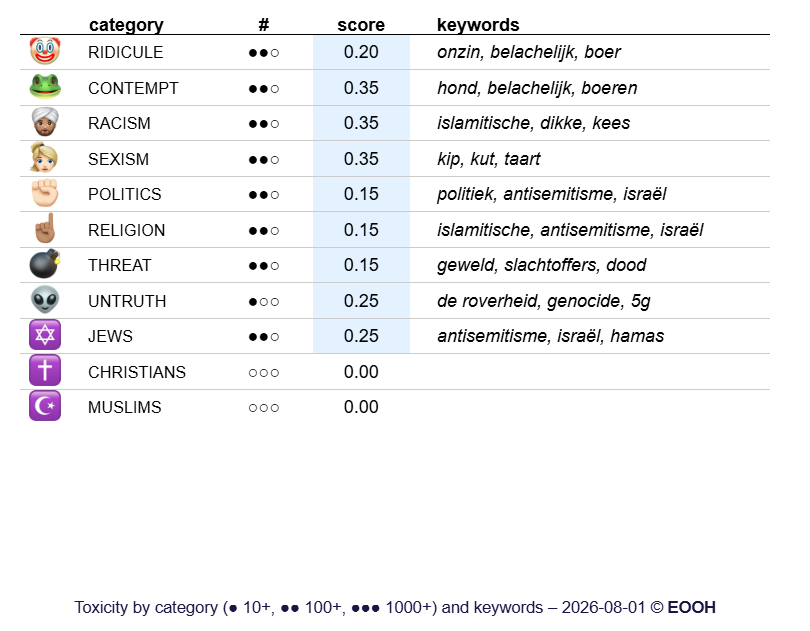
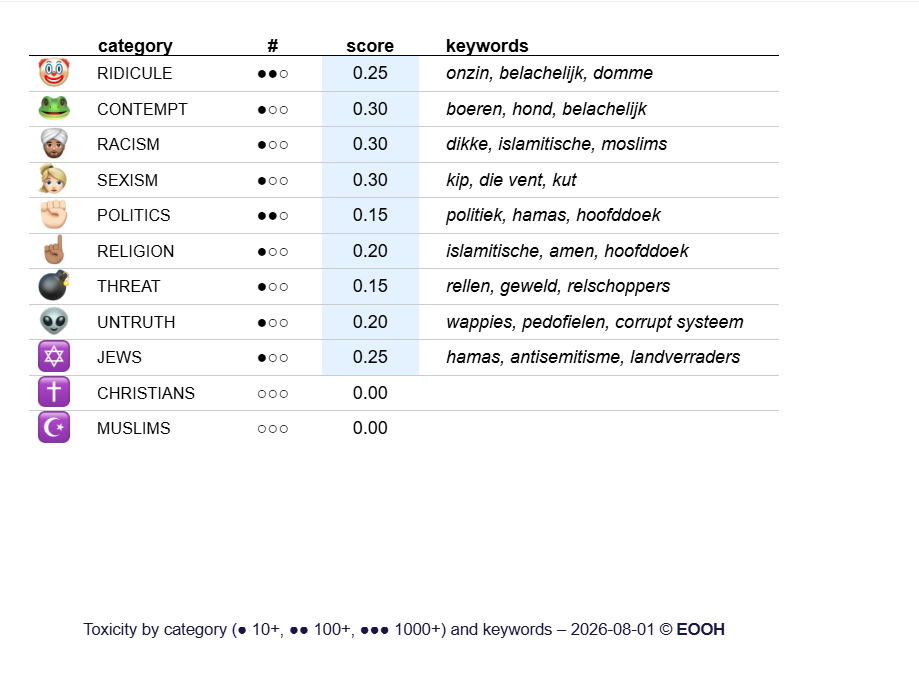
Finally, the category of hatred against Jews shows that antisemitic narratives remained strongly present throughout the quarter. Although the keywords used changed somewhat from month to month, from Israel and antisemitism in April to genocide and Holocaust in May, and Hamas and traitors in June, the themes remained clearly linked to the conflict in the Middle East. As a result, antisemitism, as in the first quarter, remained a structural component of broader political discussions online.
Overall, the tables confirm that the different forms of online toxicity remained remarkably stable throughout the second quarter. The targets and current topics changed, but the underlying patterns of political polarisation, identity-based hostility, racism, antisemitism, and threatening rhetoric remained clearly visible throughout the research period.
Analysis of the Distribution of Toxic Categories
The figures below show the number of toxic messages per category during April, May, June, and the second quarter of 2026 as a whole. The graphs distinguish between highly toxic messages (score >0.8), messages with moderate toxicity (>0.2), and messages without significant toxicity.
The results show that politics remained by far the largest source of online toxicity throughout the second quarter. In every month, this category contained the highest number of toxic messages, with April showing the highest absolute number, followed by a decline in May and a further decrease in June. Despite this decline, political content remained by far the dominant context in which toxic expressions occurred.
After politics, ridicule and contempt were the most common categories. Ridicule in particular remained strongly represented throughout all three months, indicating that insulting and derogatory communication formed a structural part of online political discussions. Contempt showed a similar pattern, although the absolute number of messages in this category was somewhat lower.
Racism and religion also consistently rank among the larger categories. Although the number of messages is lower than for political toxicity, both themes remain clearly present throughout the quarter. This is consistent with the content analysis of the keywords, which shows that discussions about migration, Islam, antisemitism, and the conflict in the Middle East are closely intertwined with political discussions.
The threat category remained relatively stable throughout the quarter. Although threatening expressions accounted for a smaller proportion than political or insulting communication, they remained clearly present in every month. The number of highly toxic threats remained limited, but the category shows that explicit violent rhetoric was a recurring feature of online discussions.
Sexism and disinformation (untruth) remained the smallest categories during the second quarter. However, it is notable that disinformation was relatively more prevalent in May than in April and June, indicating that specific societal events temporarily contributed to an increase in conspiracy-related and misleading narratives.
A second notable finding is that the relative distribution of the different categories changes very little over the course of the quarter. Although the total number of messages decreases from April to June, the ranking of the categories remains almost identical. This suggests that the underlying dynamics of online toxicity are stable: while political events lead to fluctuations in the volume of discussions, they have little impact on which forms of hostility are dominant. Political polarisation remains the main driving force, while insults, racism, religious hostility, and threats remain structurally intertwined with it.
Conclusion
The analyses of the second quarter of 2026 show that political discussions remained the main driver of online toxicity. Although the total number of messages decreased over the course of the quarter, the nature of the online discussions changed very little. Political topics consistently formed the context in which toxic expressions emerged, with insulting language, racist expressions, religious hostility, and threats remaining structurally intertwined.
Notably, the overall level of toxicity remained relatively low. Only a very small proportion of messages reached a high toxicity score. The main challenge therefore lies not so much in a large volume of extremely hateful messages, but in the continuous presence of low to moderately toxic communication. Insults, dehumanising language, threats, and polarising rhetoric occurred frequently throughout the quarter and contributed to the normalisation of hostile online communication.
The analyses also show that the underlying narratives remained remarkably stable. Discussions about domestic politics, migration, religion, and international conflicts dominated the online debate throughout the research period. At the same time, the specific topics around which these discussions developed shifted. The conflict in the Middle East in particular remained an important catalyst for online polarisation, with antisemitic and anti-Muslim narratives recurring frequently. In addition, anti-migration rhetoric, conspiracy thinking, and identity-based attacks remained visible within the same political discussions.
An important finding is that different forms of online hate increasingly occurred together. Racism, antisemitism, anti-Muslim expressions, sexism, and threats rarely appeared in isolation, but instead formed part of broader political discussions in which multiple constructions of perceived enemies were activated simultaneously. This creates an online discourse in which societal divisions reinforce one another and different forms of discrimination and exclusion intersect.
Finally, the second quarter shows that a decrease in the total number of messages does not automatically result in a decrease in online hate. Although online activity declined after April, the proportions between the different toxic categories remained almost unchanged. This indicates that online toxicity is not a temporary phenomenon linked exclusively to isolated events, but rather a structural feature of online societal debate. Current political and international developments mainly determine the intensity and specific focus of the discussions, while the underlying patterns of polarisation and hostility remain largely constant.
These findings underline the importance of continuous monitoring of online hate. Only by tracking developments over a longer period can it be determined how societal and political events influence existing hate narratives, which groups continue to be targeted by online hostility, and at what moments online discussions are at risk of further escalation.